

Will AI Take Your Job? What the Data Actually Says
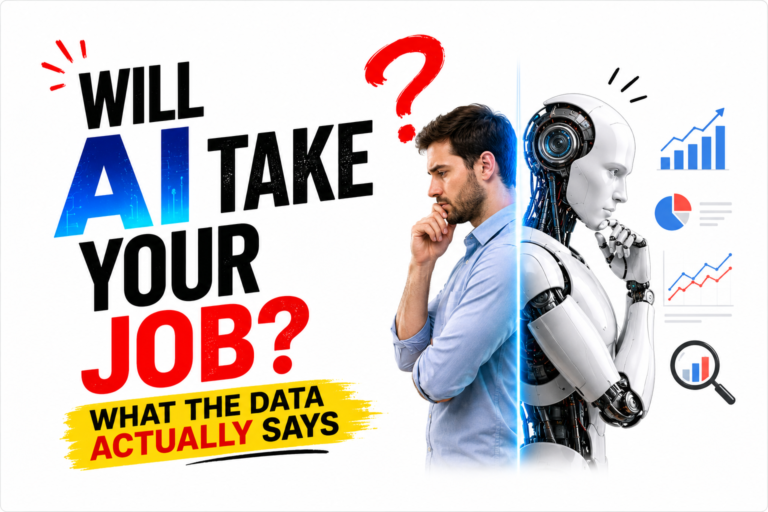
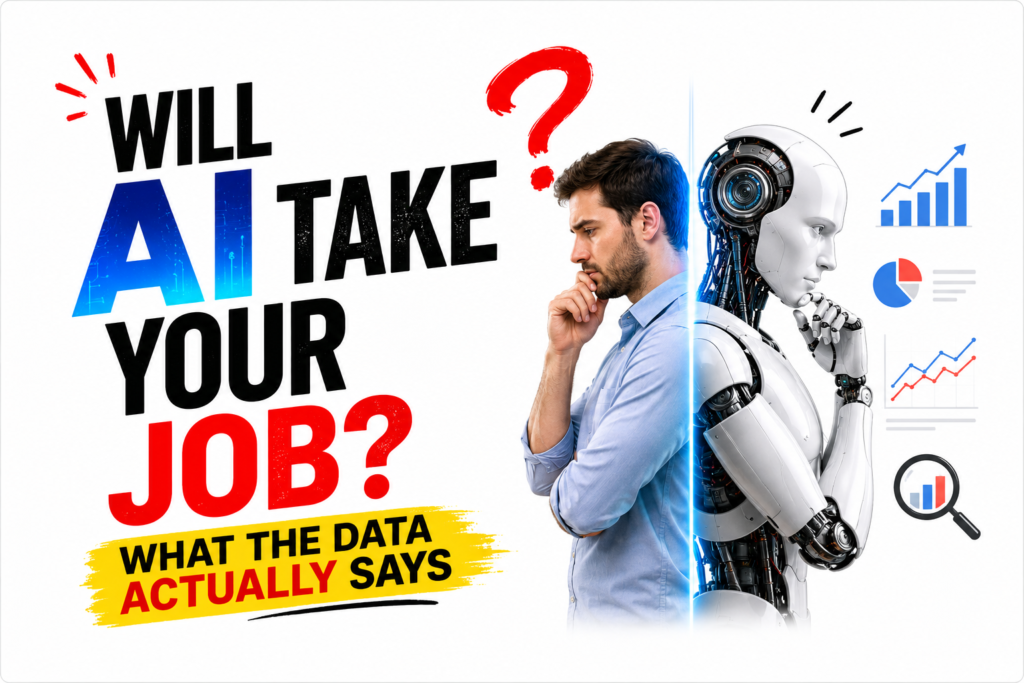
If you’re worried that AI might take your job, you’re probably asking the wrong question.
The more useful question is: Which parts of your job can AI already do, which parts still need you, and what happens when your employer expects one person to do the work of two?
That’s where the real story gets interesting.
There are plenty of dramatic headlines about AI replacing workers. At the same time, there are reports predicting millions of new jobs. Both can sound believable because, in reality, AI is doing both things at once: automating some work and changing the rest.
So, will AI take your job?
The honest answer is: for some people, parts of their work will disappear. Some jobs will shrink. Some new jobs will appear. And many existing jobs will simply become very different.
The data gives us a much more complicated picture than “AI replaces everyone.”
What the Data Actually Says About AI and Jobs
One of the clearest recent studies comes from the International Labour Organization (ILO).
Its 2025 global assessment found that around one in four workers worldwide are in occupations with some degree of exposure to generative AI.
But here’s the part that gets lost in social-media headlines: the ILO says job transformation is more likely than complete replacement for most occupations. Only about 3.3% of global employment falls into its highest exposure category.
That doesn’t mean those 3.3% of jobs will definitely disappear.
It means the tasks involved in those occupations have a comparatively high potential for automation.
That’s a very different statement.
Think about an accountant.
AI might prepare a spreadsheet, categorize transactions, summarize financial documents and draft an email.
But someone may still need to check whether the numbers make sense, communicate with a client, understand unusual transactions and take responsibility for the final decision.
The job hasn’t necessarily disappeared.
The task mix has changed.
A useful way to think about AI exposure
Imagine your job contains 20 regular tasks.
Maybe AI can completely handle 5.
It can help you with another 7.
And it can’t reliably handle the remaining 8.
Your job isn’t necessarily “80% safe” or “25% replaced.”
Instead, your daily work is being rearranged.
And that distinction matters enormously.
AI Is Already Changing Jobs — Even Without Mass Layoffs
One mistake people make is looking only for the number of jobs that disappeared.
That’s too narrow.
A job can be affected by AI without the job title disappearing from LinkedIn.
For example, a content writer might previously spend:
- 2 hours researching
- 2 hours creating an outline
- 4 hours writing
- 1 hour editing
- 1 hour formatting
With AI assistance, the same writer might spend far less time on research and first drafts.
But the client may not say:
“Great, now you have more free time.”
They may say:
“Can you deliver three articles instead of one?”
That’s the part of the AI debate people often ignore.
AI doesn’t have to eliminate a job to change the economics of that job.
If one employee can produce twice as much work, companies may need fewer people for the same amount of output.
At the same time, lower production costs can create demand for more work.
Both effects can happen.
The World Economic Forum’s Numbers Are More Complicated Than They Look
The World Economic Forum’s Future of Jobs Report 2025 projected major labour-market disruption by 2030.
It estimated that around 22% of today’s jobs could be affected by structural labour-market transformation, with approximately 170 million new roles created and 92 million displaced, resulting in a projected net increase of 78 million jobs.
But don’t read that as:
“AI will destroy 92 million jobs.”
That’s not what the report says.
The projection covers several major forces affecting employment, including technology, economic changes, demographics and the green transition.
AI is one part of the picture.
That distinction is important because online discussions often take a broad labour-market forecast and present it as a pure AI job-loss prediction.
The actual situation is much broader.
So Which Jobs Are More Exposed to AI?
The answer isn’t simply “high-paying jobs” or “low-paying jobs.”
It depends heavily on the tasks involved.
Jobs that involve large amounts of predictable, digital, text-based or computer-based work are generally easier for generative AI systems to assist with.
The ILO’s research continues to show particularly high exposure among clerical occupations.
Examples include:
- Data-entry work
- Typing and transcription
- Administrative support
- Bookkeeping tasks
- Routine documentation
- Some customer-service activities
The 2025 ILO research also found increasing exposure in highly digitized professional and technical occupations, including areas such as financial analysis, web and multimedia development and application programming.
That last point is worth paying attention to.
AI exposure isn’t limited to people doing “simple” work.
A software developer can be highly exposed to AI because code is digital and structured.
But that doesn’t automatically mean software developers disappear.
Instead, the developer may spend less time writing repetitive code and more time deciding what should be built, reviewing AI-generated code, debugging complicated problems and integrating systems.
Jobs With More Human Interaction Are Harder to Automate Completely
Imagine two workers.
Worker A spends most of the day moving information between spreadsheets.
Worker B spends most of the day visiting customers, negotiating with them, understanding their situation and solving unexpected problems.
AI can potentially help both.
But replacing the entire second job is much harder.
Why?
Because the second job contains things that aren’t simply information-processing tasks.
It involves:
- Trust
- Physical presence
- Negotiation
- Context
- Accountability
- Social judgment
- Unexpected situations
- Human relationships
That’s one reason why “AI capability” and “AI job replacement” aren’t the same thing.
A model might be capable of generating an impressive response.
That doesn’t automatically mean a company is willing to hand an important customer relationship entirely to a model.
A Simple Example: The Graphic Designer
Let’s say a graphic designer normally spends a day creating five social-media creatives.
Generative AI can now help produce concepts, backgrounds, layouts and variations very quickly.
At first, that sounds terrible for the designer.
But now consider what the client actually needs.
The client doesn’t necessarily want “an image.”
They want something that matches their brand, communicates a specific offer, fits a particular audience and performs well.
The designer who only knows how to manually create graphics may face more pressure.
The designer who understands:
design + branding + marketing + AI tools
can potentially become much more productive.
The important change isn’t simply that AI can make an image.
It’s that the value of knowing only one production step may decrease.
AI Isn’t Always Better Than Humans
This is another part of the conversation that gets ignored.
Generative AI can produce something that looks convincing while still being wrong.
It can misunderstand context.
It can invent information.
It can produce code with security or logic problems.
It can create a beautiful marketing strategy that makes absolutely no sense for the actual business.
That’s why human review remains important.
Anthropic’s Economic Index, which analyzed millions of anonymized Claude conversations, found that AI use in its initial 2025 analysis leaned toward augmentation rather than automation: 57% augmentation versus 43% automation.
In simple language:
People were often using AI with themselves, rather than simply handing the entire task over to AI.
That difference is significant.
But There Is a Real Risk for Entry-Level Workers
This is probably the part that students and freshers should pay the most attention to.
A 2026 Anthropic analysis found no systematic increase in unemployment among highly AI-exposed workers since late 2022, but it reported suggestive evidence that hiring of younger workers had slowed in some exposed occupations.
That doesn’t prove that AI caused the slowdown.
But it raises an important question.
If AI can perform some of the basic tasks traditionally given to junior employees, companies may have less reason to hire large numbers of beginners for those specific tasks.
This could change the traditional career ladder.
Previously:
Fresher → Junior → Mid-level → Senior
In some fields, it could increasingly become:
Fresher who knows the tools → Junior-level responsibilities faster
That sounds positive until you realize there is another side to it.
If companies expect beginners to be productive immediately, simply having a degree may become less valuable by itself.
The Biggest Risk May Not Be “AI Replacing You”
Here’s the uncomfortable possibility.
You may not lose your job to AI.
You may lose part of your job to someone who knows how to use AI better.
Imagine two employees doing similar work.
Employee A takes six hours to complete a task manually.
Employee B uses AI for research, drafts, analysis and repetitive work, then spends time checking and improving the output.
Employee B finishes in two hours.
If the quality is similar, the employer has a business reason to prefer the second workflow.
That’s not a prediction that every AI-skilled employee will replace everyone else.
It’s simply how productivity competition works.
Technology changes the amount of output one worker can produce.
What Happens to Salaries?
This is where you should be careful with confident predictions.
There isn’t enough evidence to say:
“AI will make everyone’s salary higher.”
There also isn’t enough evidence to say:
“AI will reduce everyone’s salary.”
The outcome can differ by occupation.
If AI makes a skill easier to obtain, the market value of that specific skill may fall.
But if AI increases demand for another skill, its value can rise.
For example, basic copy generation may become cheaper.
But someone who can combine:
market research + strategy + copywriting + conversion optimization + AI
may become more useful.
The value moves toward the combination.
What AI Could Mean for Your Particular Job
Instead of asking:
“Will AI take my job?”
Try asking these five questions.
1. How repetitive is my work?
If you repeat the same digital process every day, AI exposure may be higher.
2. How much of my work happens on a computer?
Digital tasks are generally easier for AI systems to assist with than physical tasks.
3. Does my job require judgment?
If mistakes have serious consequences, human review may remain important.
4. Do I deal with people?
Negotiation, trust, leadership and relationship-building are different from generating text.
5. Can I combine AI with another valuable skill?
This may be the most useful question.
Don’t become “the person who knows ChatGPT.”
Become the person who knows marketing + AI, finance + AI, coding + AI, design + AI, research + AI, or whatever combination fits your career.
What Should You Actually Do If You’re Worried?
You don’t need to spend ₹1 lakh on an AI course tomorrow.
You don’t need to learn 50 AI tools.
And you definitely don’t need to quit your current career because a YouTube thumbnail said your profession is “dead.”
Start much smaller.
Step 1: Write down your weekly tasks
Take 20 minutes.
Write down everything you do during a normal workweek.
For example:
- Writing emails
- Creating reports
- Research
- Data entry
- Customer replies
- Presentations
- Coding
- Editing
- Meetings
- Documentation
Then mark every task:
A = AI can probably do most of it
B = AI can assist me
C = AI currently doesn’t help much
This gives you something much more useful than an abstract fear about AI.
You get a personal AI-risk map.
Step 2: Automate one boring task
Don’t start with your most important responsibility.
Pick something repetitive.
For example:
Before:
Collect information → organize it → summarize it → write email → format it
After:
Collect information → use AI to organize/summarize → personally verify → send
Your first goal isn’t becoming an “AI expert.”
It’s saving 30–60 minutes per week.
Once that works, automate another task.
Step 3: Learn verification, not just prompting
This is underrated.
Anyone can ask an AI:
“Write me a report.”
The valuable person knows how to ask:
- Is this information correct?
- Where did this number come from?
- What assumptions were made?
- What did the AI miss?
- What could go wrong?
- Does this actually solve the customer’s problem?
AI literacy isn’t just knowing how to generate answers.
It’s knowing when not to trust the answer.
What If You’re a Student or Fresher?
Don’t try to compete with AI at being fast.
You’re probably not going to beat a machine at generating 20 variations of a paragraph.
Instead, build something around AI.
For example:
Marketing student
Learn:
Digital marketing + analytics + AI
Computer science student
Learn:
Programming + system design + AI-assisted development
Finance student
Learn:
Financial analysis + Excel + AI + data interpretation
Designer
Learn:
Design principles + branding + AI image tools
Writer
Learn:
Research + editing + SEO + AI-assisted writing
The exact combination depends on your field.
But the principle is simple:
Don’t build your entire career around a task that technology is rapidly making cheaper.
Build around the larger problem that task was helping solve.
What Jobs Are Probably Safer?
I wouldn’t use the word “safe.”
No serious researcher can guarantee that a particular occupation will be untouched by technological change.
But some types of work currently have characteristics that make complete automation harder.
These can include jobs involving:
- Physical environments
- Human care
- Leadership
- Complex negotiation
- High-stakes decisions
- Strong interpersonal relationships
- Hands-on technical work
- Responsibility and accountability
Even here, AI can still change the workflow.
A doctor can use AI.
A teacher can use AI.
A plumber can use AI.
A manager can use AI.
A construction worker can use AI.
“AI-resistant” doesn’t mean “AI-free.”
The Part Nobody Can Predict Yet
There is a temptation to create a neat list:
These 20 jobs will disappear by 2030.
Be skeptical of that.
The ILO itself emphasizes that exposure indicators have limitations and should not be treated as direct predictions of employment outcomes.
Why?
Because technology isn’t adopted in a vacuum.
A company might technically be able to automate something but decide not to because:
- It costs too much.
- Customers don’t like it.
- Regulations create restrictions.
- The AI makes too many mistakes.
- Integration is difficult.
- Employees already perform the task cheaply.
- A human is legally or practically responsible.
Technical possibility is not the same as economic adoption.
And economic adoption is not the same as job elimination.
AI Will Probably Create Winners and Losers
That’s not necessarily because AI is “good” or “bad.”
It’s because technological changes redistribute demand.
Some tasks become cheaper.
Some become more valuable.
Some disappear.
New tasks appear.
The World Economic Forum expects technology-related skills to grow alongside human skills such as cognitive abilities and collaboration through 2030.
That’s a useful signal.
The future isn’t necessarily:
Humans vs AI.
For many workers, it may be:
Humans using AI vs humans using older workflows.
But even that isn’t guaranteed.
Different industries will move at different speeds.
So, Will AI Take Your Job?
Maybe.
But the data doesn’t support the simple idea that AI is about to eliminate everyone’s employment.
The stronger evidence points toward task-level transformation.
The ILO’s 2025 research estimates that one in four workers are in occupations with some exposure to generative AI, while most affected jobs are expected to be transformed rather than completely eliminated.
At the same time, there are genuine risks.
Some routine jobs are highly exposed.
Some entry-level work could become harder to access.
Some companies may need fewer workers for certain tasks.
And workers who don’t adapt may face more competition from workers who can produce the same output faster.
So don’t ignore AI.
But don’t panic either.
Will AI Take Your Job?
The more useful question is:
How much of your current work can AI already do, and what valuable work can you learn to do around it?
That’s something you can actually act on.
Your Next Step: Do This Tonight
Don’t buy another course.
Don’t spend three hours watching “AI will replace 50% of jobs” videos.
Open a blank document and write down 10 tasks you perform regularly at work or college.
For each one, mark:
Can AI do it?
Can AI assist with it?
Does it require human judgment?
Then choose one task and test an AI-assisted workflow for the next seven days.
Measure the result.
If it takes you 60 minutes today, see whether you can bring it down to 40 minutes without reducing quality.
That’s a much more useful response to the AI revolution than worrying about a prediction for 2030.
Because the future of work isn’t decided by a headline.
It’s being built task by task, workplace by workplace, right now.
Stay Connected for More AI & Wearable Tech Updates!
Don’t miss the latest updates on AI wearables, Samsung Health, Google Health Coach, smartwatches, health tracking, and preventive healthcare technology. Follow our social channels to stay updated with the latest developments in AI-powered health technology:
- 📺 YouTube: Watch detailed explainers, AI wearable comparisons, product updates, and the latest health-tech trends — Subscribe to Our YouTube Channel
- 📸 Instagram: Follow us for quick tech updates, AI wearable insights, health-tracking features, and informative visual content — Follow Us on Instagram
- 📘 Facebook: Join the discussion and share your thoughts on Samsung, Google, AI-powered wearables, and the future of personalized healthcare — Follow Our Facebook Page
- 🌐 Website: Explore more articles covering AI, smart wearables, health technology, and the future of preventive care — Visit Our Website