


The job search process has completely changed.
If you’re still spending hours manually rewriting your resume, creating cover letters from scratch, filling out repetitive application forms, and tracking every application in a spreadsheet, you’re making your job search harder than it needs to be.
Today, AI tools for job seekers can help with almost every stage of the process—from finding relevant jobs and tailoring resumes to tracking applications, researching companies, and practicing interviews.
But there is a catch.
Not every AI job search tool does the same thing.
Some tools are built specifically for ATS resume optimization. Others focus on automated job applications. Some help you prepare for interviews, while others are designed to keep your entire job search organized.
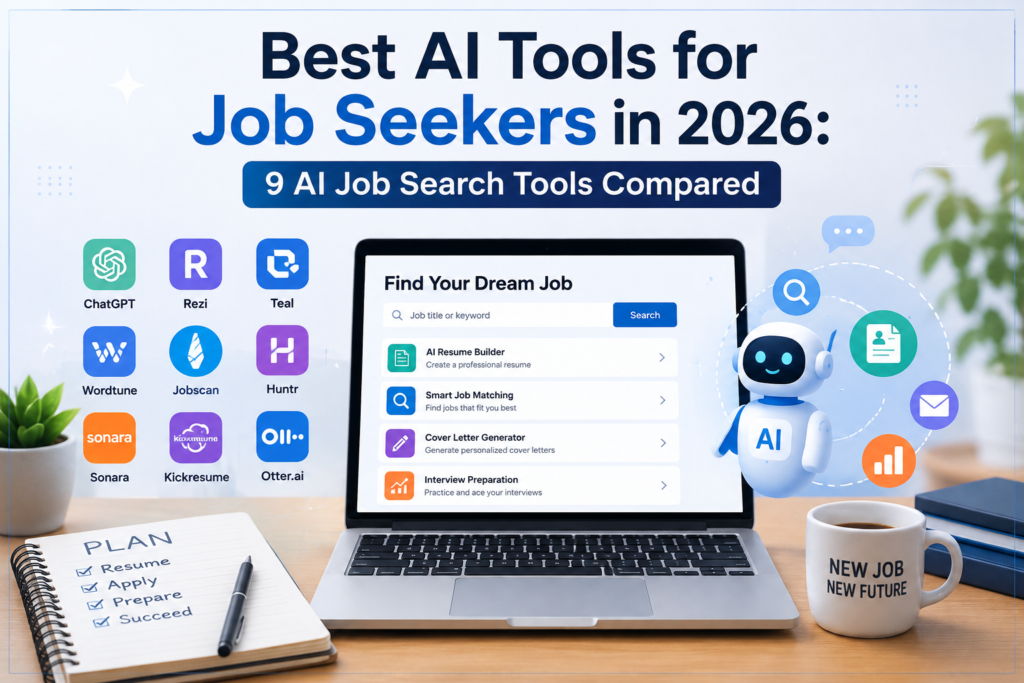
After comparing the major categories and reviewing the tools covered in this guide, I’ve narrowed down the best AI tools for job seekers in 2026 to nine practical options.
The goal isn’t to tell you to use every tool on this list. It’s to help you understand which tool solves which problem so you can build a job-search workflow that actually makes sense.
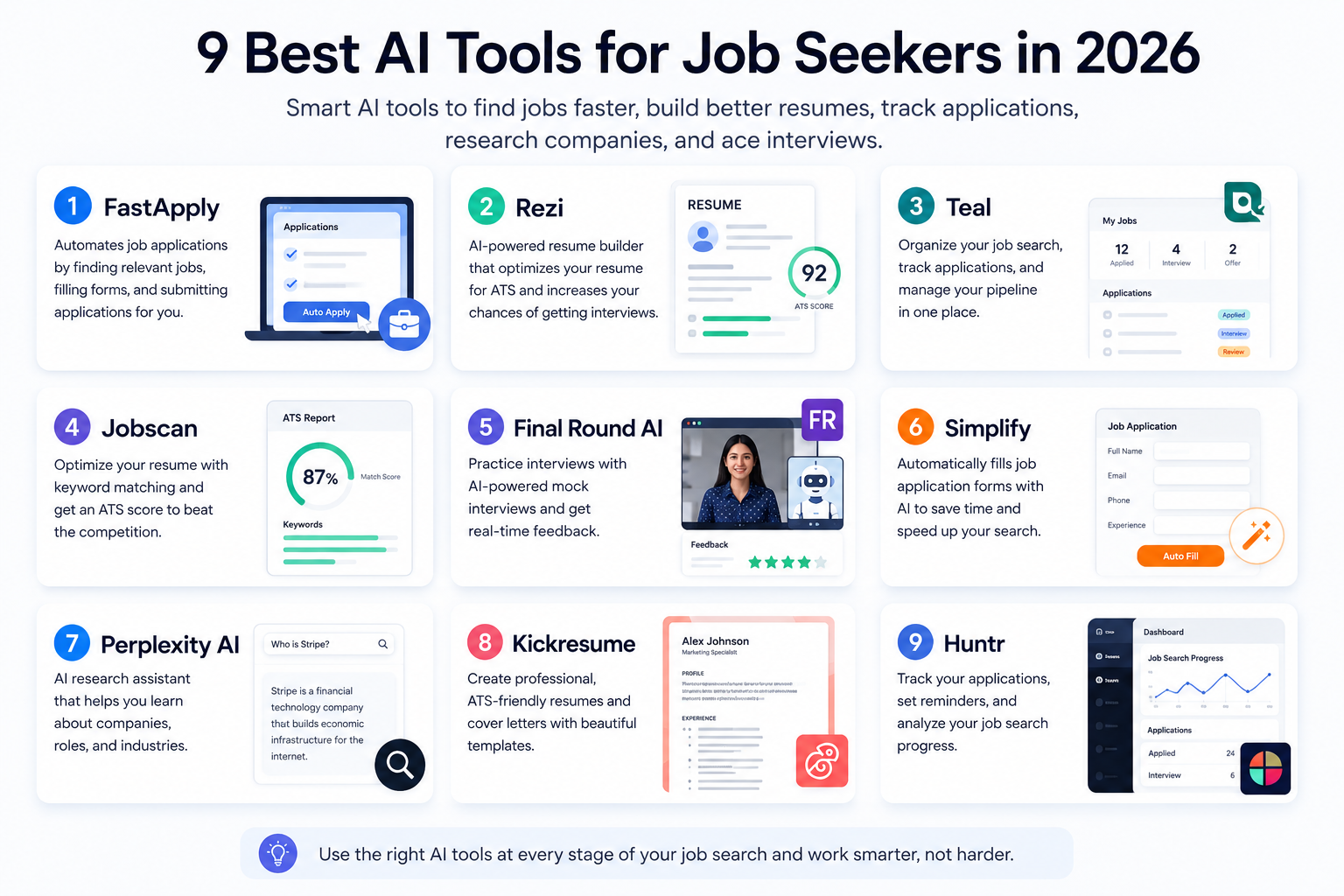
Best AI Tools for Job Seekers in 2026: Quick Comparison
| AI Tool | Best For | Main Category | ATS Support | Application Automation | Best Use |
|---|---|---|---|---|---|
| FastApply | Automated applications | Auto-Apply | Yes | Yes | High-volume applications |
| Rezi | Resume optimization | AI Resume Builder | Excellent | No | ATS-focused resumes |
| Teal | Job search organization | Application Tracker | Yes | No | Managing applications |
| Jobscan | Keyword matching | ATS Auditor | Excellent | No | Competitive corporate jobs |
| Final Round AI | Interview preparation | AI Interview Coach | Basic | No | Mock interviews |
| Simplify | Application autofill | Job Search Assistant | Yes | Autofill | Faster applications |
| Perplexity AI | Company research | AI Research | No | No | Interview research |
| Kickresume | Resume design | Resume Builder | Yes | No | Creative professionals |
| Huntr | Application tracking | Job Tracker | No | No | Organizing job searches |
What Are AI Job Search Tools?
AI job search tools are software platforms that use artificial intelligence to help automate, analyze, or improve different parts of the job-search process.
Instead of treating the entire job search as one task, it’s better to break it into separate stages:
- Finding relevant jobs
- Creating or tailoring your resume
- Optimizing your resume for ATS systems
- Completing applications
- Tracking applications
- Researching companies
- Preparing for interviews
- Following up with recruiters
The original research behind this guide also separates AI job-search software into five core categories: auto-apply tools, ATS resume tools, interview coaches, application trackers, and research/communication copilots.
That distinction matters because the best AI tool for job seekers depends heavily on where you’re struggling.
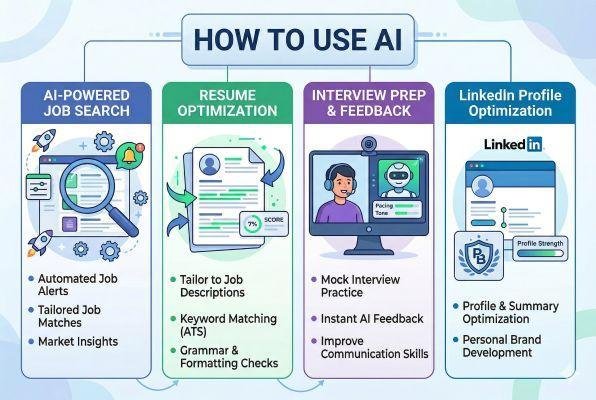
The 5 Main Categories of AI Tools for Job Seekers
1. AI Auto-Apply Tools
These platforms are designed to reduce repetitive work involved in submitting applications.
They can help with job matching, application forms, resume tailoring, and—in some cases—automated submission.
Best for: People applying to a high number of jobs.
2. AI Resume and ATS Tools
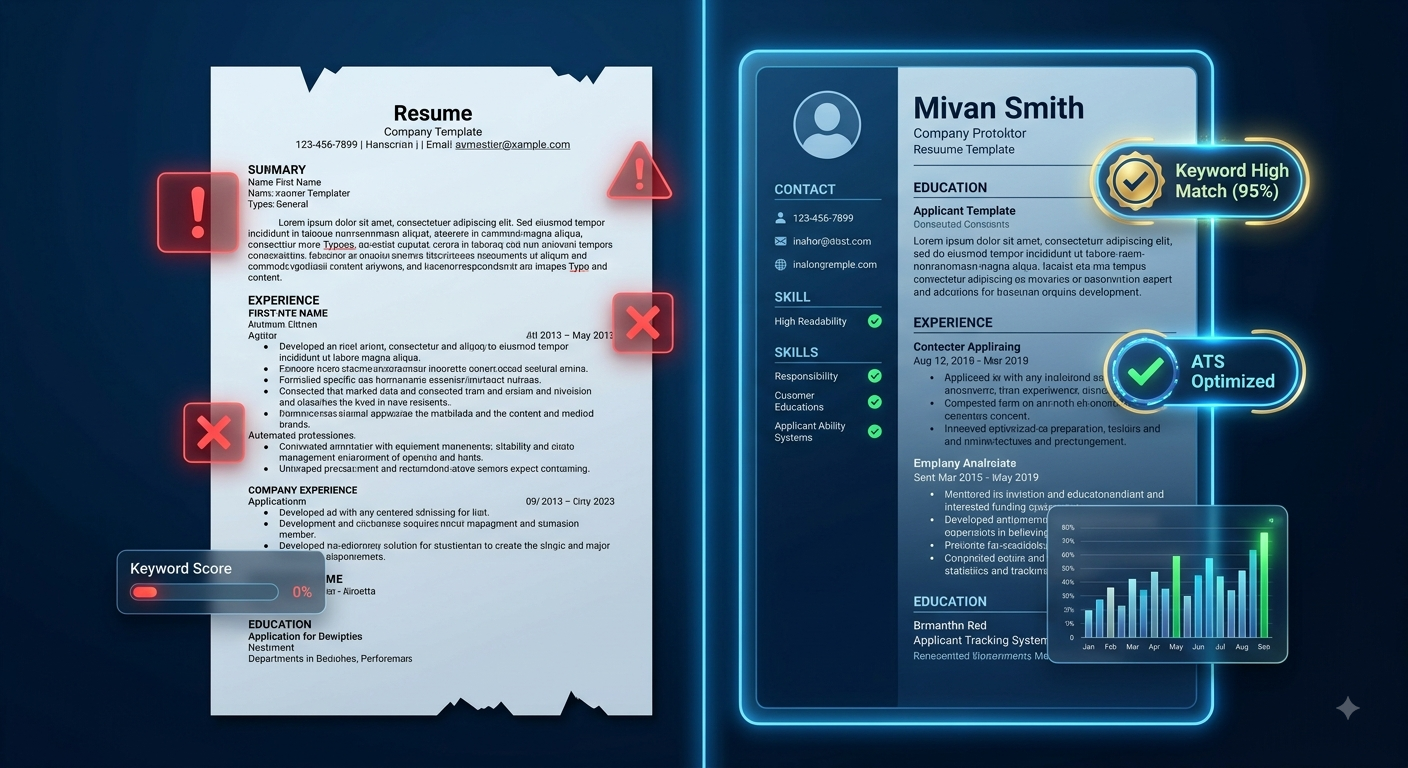
These tools analyze your resume against a job description and help improve keyword alignment, formatting, structure, and bullet points.
Best for: Candidates who are applying but aren’t getting enough interviews.
3. AI Interview Preparation Tools
These platforms help you practice behavioral and technical questions, simulate interviews, and improve the quality of your answers.
Best for: Candidates who are already getting interviews.
4. AI Application Trackers
Application trackers help you organize saved jobs, submitted applications, interviews, contacts, and follow-ups.
Best for: Anyone managing multiple applications at once.
5. AI Research Tools
Research-focused AI tools can help you understand a company, its competitors, recent announcements, products, executives, and industry trends.
Best for: Candidates preparing for interviews or networking conversations.
1. FastApply: Best AI Tool for Automated Job Applications
If your biggest problem is simply the amount of time it takes to apply for jobs, FastApply is one of the most interesting options in this category.
The original review positioned FastApply as an all-in-one auto-apply and resume-tailoring platform, with a workflow that combines job matching, resume customization, application submission, and tracking.
Why FastApply Stands Out
The main advantage is volume combined with personalization.
Instead of manually opening every job listing, copying requirements, modifying your resume, and filling out the same information repeatedly, an automation-focused platform can reduce much of that repetitive work.
Key Features
- AI job matching
- Resume tailoring
- Automated application workflows
- Job tracking
- Keyword alignment
- Auto-apply functionality
Best For
FastApply is best for active job seekers who are applying to many positions and want to spend less time on repetitive application tasks.
The Important Catch
Automation isn’t a substitute for job targeting.
Before using an auto-apply system, define:
- Target job titles
- Minimum salary
- Preferred location
- Remote or hybrid preference
- Experience level
- Industries you want to avoid
Otherwise, you can end up with a large number of applications but very little relevance.
My Take
Use automation to save time, but don’t optimize your entire strategy around application quantity.
The best results usually come from combining automation with a strong resume and clear job targeting.
2. Rezi: Best AI Resume Builder for ATS Optimization
If your main goal is to create a stronger ATS-friendly resume, Rezi deserves serious consideration.
Rezi currently offers AI resume creation, resume scoring, keyword targeting, AI editing, ATS-friendly formatting, cover-letter tools, job search, and AI interview features. (Rezi)
Why Rezi Is One of the Best AI Tools for Job Seekers
A good resume isn’t simply a document filled with keywords.
It needs to communicate your experience clearly while also using relevant terminology from the job description.
Rezi’s keyword-targeting functionality is designed to help tailor resume content to individual job requirements. (Rezi)
Key Features
- AI resume builder
- Resume scoring
- Keyword targeting
- ATS-friendly formatting
- AI bullet-point rewriting
- Resume editing
- Cover letter generation
- Job search
- AI interview preparation
Pricing
Rezi currently offers a free plan, a $29/month Pro plan, and a $149 Lifetime plan. (Rezi)
Best For
Rezi is especially useful for:
- Recent graduates
- Career changers
- Corporate job seekers
- Technical professionals
- Candidates applying to ATS-heavy hiring processes
My Take
The biggest mistake with AI resume tools is trying to maximize a score instead of improving the actual resume.
Use AI to identify missing terminology and improve clarity, but only include skills and achievements that genuinely match your experience.
3. Teal: Best AI Job Search Tool for Application Tracking
Once you start applying to multiple jobs, organization becomes a serious problem.
You may remember the company but forget the application date.
You may remember the interview but forget which resume version you submitted.
This is where Teal becomes useful.
Teal’s current job-search functionality includes job discovery and alerts, while its broader platform is designed around career and job-search organization. (Teal Knowledge Base)
What Teal Helps You Do
A typical application pipeline can look like:
Saved → Applied → Interview → Offer
Instead of managing everything in a spreadsheet, you can keep your job-search information centralized.
Key Features
- Job search
- Application tracking
- Resume management
- Job bookmarking
- Keyword matching
- Career organization
- Browser tools
Best For
Teal is particularly useful if you’re managing dozens of opportunities simultaneously.
My Take
Don’t wait until your job search becomes chaotic.
Create a tracking system from your first application.
Record:
- Company
- Position
- Date applied
- Resume version
- Recruiter
- Interview date
- Follow-up date
- Application status
That information becomes extremely valuable once you start getting multiple interviews.
4. Jobscan: Best AI Tool for ATS Keyword Matching
Jobscan focuses heavily on one specific problem:
How closely does your resume match the job description?
This makes it particularly useful for applicants targeting competitive corporate positions.
Why Jobscan Is Different
Instead of simply helping you write a resume, an ATS-focused tool can identify important terminology and skill gaps between your resume and a specific job posting.
For example, a job description might repeatedly mention:
- Stakeholder management
- SQL
- Agile
- Data analysis
- Project management
If your resume demonstrates those skills but uses completely different terminology, you may have an opportunity to improve the wording.
Key Features
- Resume-to-job-description comparison
- Keyword analysis
- Skill matching
- ATS optimization
- Formatting checks
- Resume feedback
Best For
Jobscan makes the most sense for:
- Corporate roles
- Fortune 500 applications
- Technical positions
- Competitive job postings
- Candidates who already have a resume but want to improve its alignment
Important Warning
Don’t chase a 100% match score.
A resume that contains every keyword from a job description can sound unnatural.
The goal is to make your resume more relevant, not to turn it into a keyword database.
5. Final Round AI: Best AI Interview Tool for Job Seekers
Getting an interview is only half the battle.
Once you’re invited to an interview, the focus shifts from ATS optimization to communication and preparation.
Final Round AI is designed around interview preparation, including mock interviews and role-specific practice. The original review highlighted its use for behavioral interview preparation and the STAR framework.
Key Features
- AI mock interviews
- Interview question generation
- Behavioral interview practice
- Role-specific questions
- Answer feedback
- Interview preparation
Best For
Final Round AI can be useful for:
- Technical interviews
- Behavioral interviews
- Panel interviews
- Senior-level interviews
- Candidates who struggle with interview confidence
Use the STAR Method
For behavioral questions, structure your answers around:
S — Situation
T — Task
A — Action
R — Result
Don’t just explain what you did.
Explain the outcome.
Instead of:
I managed a marketing campaign.
Try:
I managed a campaign that increased qualified leads by 28% over three months.
Specific outcomes make your experience much easier for an interviewer to understand.
6. Simplify: Best Free AI Job Application Assistant
Simplify is particularly interesting for job seekers who want to speed up applications without completely handing over control.
Its current platform combines job matching, AI resume tailoring, application autofill, ATS feedback, and job tracking. Simplify says its base job tracking and autofill functionality is free. (Simplify Jobs)
Why Simplify Is Useful
The repetitive parts of an application are often the most frustrating.
You repeatedly enter:
- Name
- Address
- Education
- Employment history
- Skills
- Screening answers
- Contact details
Simplify’s Copilot can autofill repetitive application questions while also helping identify missing resume keywords. (Simplify Jobs)
Key Features
- Job matching
- Application autofill
- AI resume builder
- Resume ATS score
- Keyword suggestions
- Job tracker
- Cover letter tools
Best For
Simplify is a strong option for people who want more speed while still reviewing applications manually.
My Take
Autofill should save you time—not remove your judgment.
Always check automatically populated answers before submitting.
7. Perplexity AI: Best AI Research Tool for Job Seekers
Company research is one of the most overlooked parts of interview preparation.
Perplexity is useful here because it combines conversational AI with web search and source-backed answers.
Perplexity describes itself as an AI-powered search engine that searches the web and provides conversational answers with citations and links to original sources. (Perplexity AI)
What You Can Research
Before an interview, use it to investigate:
- Recent company announcements
- Product launches
- Competitors
- Industry trends
- Company strategy
- Executive backgrounds
- Market developments
Better Prompt Example
Instead of asking:
Tell me about Microsoft.
Ask:
What are the three biggest strategic priorities of [Company] in 2026, what products have they launched recently, and what challenges could affect this role?
The second prompt gives you information that is much more useful for interview preparation.
Best For
Perplexity is particularly useful for:
- Company research
- Interview preparation
- Market research
- Competitor analysis
- Industry research
Important Tip
Use cited sources to verify important information.
AI-generated research should help you find information faster, not replace your own fact-checking.
8. Kickresume: Best AI Resume Tool for Visual Design
Not every job seeker wants the same resume style.
A traditional corporate role may benefit from a clean, simple resume.
A creative role may allow more visual personality.
Kickresume focuses on resume creation, templates, AI writing assistance, cover letters, and related career documents.
Key Features
- AI resume builder
- Resume templates
- AI writing assistant
- Cover letter builder
- ATS-related tools
- Personal website creation
Best For
Kickresume can be useful for:
- Designers
- Marketers
- Creative professionals
- Students
- Candidates who care about visual presentation
My Take
Don’t confuse visual design with resume effectiveness.
For ATS-heavy applications, prioritize:
Clear structure + readable formatting + relevant experience + natural keywords.
9. Huntr: Best Simple AI Job Application Tracker
Huntr focuses primarily on organizing your job search.
Its current Job Tracker is designed to organize applications, contacts, documents, and job-search activity in one place. (Huntr Help Center)
A Simple Job Search Pipeline
Wishlist → Applied → Interview → Offer
This visual approach can make it easier to see exactly where every opportunity stands.
Key Features
- Job tracking
- Application organization
- Contact management
- Job-board tools
- Documents
- Interview timeline
- Application notes
Best For
Huntr is a good choice if your main problem isn’t resume writing or interview preparation—it’s simply keeping your job search organized.
Best AI Job Search Tool Stacks for 2026
You don’t need all nine tools.
In fact, using too many tools can make your workflow more complicated.
A better approach is to build a small stack around the biggest problem you’re trying to solve.
Stack 1: High-Volume Job Applications
FastApply + Teal + Perplexity
Use:
- FastApply for application automation
- Teal for tracking
- Perplexity for company research
This is best for active job seekers who are applying frequently.
Stack 2: Resume and ATS Optimization
Rezi + Jobscan + Teal
Use:
- Rezi for building and tailoring the resume
- Jobscan for deeper keyword analysis
- Teal for application tracking
This is the better option if you’re submitting applications but receiving very few interviews.
Stack 3: Interview Preparation
Rezi + Perplexity + Final Round AI
Use:
- Rezi to align your resume with the role
- Perplexity to research the company
- Final Round AI to practice interviews
This is especially useful once you’re already getting interview invitations.
Stack 4: Low-Cost Job Search
Simplify + Teal + Perplexity
If you want to keep your expenses low, start with tools that cover the basics of job discovery, autofill, tracking, and research.
You don’t need to buy five subscriptions on day one.
AI Tools for Job Seekers vs. AI Tools for Business
AI isn’t only useful for finding employment.
Many job seekers are also freelancers, creators, consultants, or people building side businesses.
If you’re using AI beyond your career search, you can explore best AI tools for business in 2026 to compare AI solutions for productivity, automation, research, and business workflows.
This makes sense particularly for professionals who want to use the same AI skills in both their job search and their work.
AI Tools for Job Seekers Who Are Building Online Income
Some job seekers aren’t looking exclusively for traditional employment.
They may also be building:
- Affiliate websites
- Freelance businesses
- Content businesses
- Personal brands
- Digital products
For those workflows, AI tools for affiliate marketing can help with areas such as content planning, research, and repetitive marketing tasks.
The important point is to choose tools according to the task rather than collecting AI software simply because it’s popular.
Free AI Tools for Marketing Can Also Help Your Job Search
Marketing skills are useful even when you’re applying for jobs.
For example, if you’re building a personal brand, promoting freelance services, or creating professional content, free AI tools for marketing can help with content ideas, research, writing, and campaign planning.
This can be particularly useful for marketers and creators who want to demonstrate practical AI experience while looking for their next opportunity.
Common Mistakes to Avoid When Using AI Job Search Tools
1. Submitting an AI-Generated Resume Without Reviewing It
AI can make writing sound polished while accidentally making it generic or inaccurate.
Always check:
- Job titles
- Dates
- Skills
- Achievements
- Metrics
- Responsibilities
Your resume should represent your actual experience.
2. Applying to Every Job Automatically
More applications don’t automatically mean more interviews.
If your targeting is poor, automation can simply increase the number of irrelevant applications.
Set clear filters before using automation.
3. Keyword Stuffing Your Resume
ATS optimization is useful.
Keyword stuffing is not.
Only include skills and terminology that genuinely relate to your experience.
4. Sending the Same AI Cover Letter Everywhere
Generic AI introductions are easy to recognize.
Instead, customize the opening around:
- The company
- The role
- A relevant company development
- Your most relevant achievement
Even a few personalized sentences can make the application feel much more authentic.
5. Using Too Many AI Tools
This is an underrated problem.
You don’t need:
- Three resume builders
- Two application trackers
- Four interview coaches
- Five AI writing assistants
Choose one tool for each major bottleneck.
A simple workflow is usually easier to maintain.
How to Use AI Throughout Your Job Search
The most effective approach is to use AI at each stage without allowing it to take over your decision-making.
Step 1: Find the Right Jobs
Use job boards and AI-powered job matching to identify positions that actually fit your background.
Don’t apply simply because the title sounds interesting.
Step 2: Tailor Your Resume
Compare your resume with the job description.
Identify relevant:
- Skills
- Tools
- Responsibilities
- Industry terms
- Achievements
Then tailor your resume naturally.
Step 3: Complete the Application
Use autofill or automation to reduce repetitive work.
But review everything before submitting.
Step 4: Track Your Applications
Record:
- Company
- Job title
- Date applied
- Resume version
- Recruiter
- Interview date
- Follow-up date
- Current status
Step 5: Research the Company
Before the interview, understand the company beyond its homepage.
Research:
- Products
- Competitors
- Recent news
- Leadership
- Industry trends
- Business priorities
Step 6: Practice the Interview
Use an AI interview tool to practice likely questions.
Then practice answering those questions out loud.
Typing an answer and actually speaking an answer are two very different experiences.
Step 7: Follow Up
After an interview, send a short and personalized follow-up message.
Don’t rely on a generic AI-generated paragraph.
Are AI Job Search Tools Worth It?
Yes—but only if they solve a real problem.
If you spend hours tailoring every resume, an AI resume tool can save time.
If you repeatedly type the same information into job applications, an autofill tool can help.
If you’re losing track of applications, a tracker can make your process much easier.
And if you’re getting interviews but struggling to convert them into offers, an AI interview tool may provide more value than another resume builder.
The key is to identify your bottleneck first.
Which AI Tool Should You Choose?
Best AI tool for automated applications
FastApply
Best suited for job seekers who want to reduce repetitive application work.
Best AI resume tool
Rezi
A strong option for ATS-focused resume creation, keyword targeting, and resume optimization. (Rezi)
Best AI job application tracker
Teal or Huntr
Best for organizing multiple applications, contacts, interviews, and follow-ups.
Best ATS keyword tool
Jobscan
Best for candidates who want deeper resume-to-job-description analysis.
Best AI interview tool
Final Round AI
Best for candidates who are already getting interviews and want structured practice.
Best free AI job application assistant
Simplify
A useful option for job matching, autofill, resume tailoring, and tracking. (Simplify Jobs)
Best AI research tool
Perplexity
Best for company, market, and interview research using source-backed web results. (Perplexity AI)
Best AI resume design tool
Kickresume
Best for candidates who want stronger visual presentation alongside resume-building tools.
Final Verdict: The Best AI Tools for Job Seekers in 2026
There isn’t one AI tool that is perfect for every job seeker.
The best AI tools for job seekers are the ones that solve the specific problem slowing down your job search.
If you need application automation, start with FastApply.
If your resume needs better ATS optimization, consider Rezi or Jobscan.
If you’re struggling to organize applications, Teal or Huntr can help.
If you’re already getting interviews, focus on Final Round AI and Perplexity.
If you want a practical starting point without building a complicated software stack, Simplify + Teal + Perplexity is a sensible combination.
The real advantage of AI isn’t simply sending more applications.
It’s reducing repetitive work so you can spend more time on the parts of a job search that require human judgment:
choosing the right opportunities, communicating your value, building relationships, researching employers, and performing well in interviews.
That’s what makes AI genuinely useful for job seekers in 2026.
Frequently Asked Questions
What are the best AI tools for job seekers in 2026?
The best tool depends on your goal. Rezi and Jobscan are useful for resume and ATS optimization, FastApply and Simplify can help with application workflows, Teal and Huntr focus on tracking, Perplexity is useful for company research, and Final Round AI focuses on interview preparation.
What is the best AI resume builder for job seekers?
Rezi is a strong choice for job seekers who want AI-assisted resume creation, keyword targeting, resume scoring, and ATS-friendly formatting. (Rezi)
Can AI tools automatically apply for jobs?
Some AI job-search platforms can automate parts of the application process. Other tools focus on autofill and still require you to review and submit the application manually.
Always review an automated application before submission.
What is the best free AI tool for job applications?
Simplify is a useful free starting point because its platform includes job matching, application autofill, resume tools, and job tracking. Simplify states that its base job tracking and autofill functionality is free. (Simplify Jobs)
Can AI help me beat ATS systems?
AI can help you make your resume more relevant to a job description by identifying important terminology, improving structure, and highlighting relevant skills.
However, there is no legitimate shortcut that guarantees an ATS will accept your resume.
The best approach is to create a clear, accurate, relevant resume that naturally reflects the requirements of the role.
Should I use AI to write my resume?
Yes, but treat AI as an assistant rather than the author of your career history.
Use it to improve wording, structure, clarity, keyword alignment, and bullet points.
Never let it invent experience, qualifications, or achievements.
Is ATS optimization the same as keyword stuffing?
No.
ATS optimization means making sure your resume clearly communicates relevant experience and uses appropriate terminology from the job description.
Keyword stuffing means adding excessive or irrelevant keywords simply to increase a matching score.
The first can improve relevance. The second can make your resume difficult for humans to read.
How many AI job search tools do I need?
You usually don’t need many.
A practical setup can include:
One resume tool + one application assistant + one tracker + one interview/research tool.
Start small and add another tool only when you identify a specific problem.
Can AI guarantee a job?
No.
AI tools can improve efficiency, organization, resume quality, research, and interview preparation, but they cannot guarantee an interview or job offer.
Your experience, qualifications, targeting, communication, and interview performance still matter.
What is the best AI job search strategy?
The strongest approach is to use AI for repetitive and analytical tasks while keeping important decisions under human control.
Use AI to:
- Find opportunities
- Tailor resumes
- Analyze job descriptions
- Autofill applications
- Track your search
- Research companies
- Practice interviews
But you should still decide which jobs are worth applying for and how you want to present your experience.













2 thoughts on “Best AI Tools for Job Seekers in 2026: 9 AI Job Search Tools Compared”