
Artificial intelligence is moving far beyond chatbots and productivity apps. One of its most interesting applications is AI in healthcare, where smartwatches, sensors and health platforms can continuously collect and interpret personal health data.
Instead of simply counting steps or displaying heart-rate charts, the next generation of AI wearables is being designed to understand patterns across different signals, including heart activity, sleep, movement and glucose.
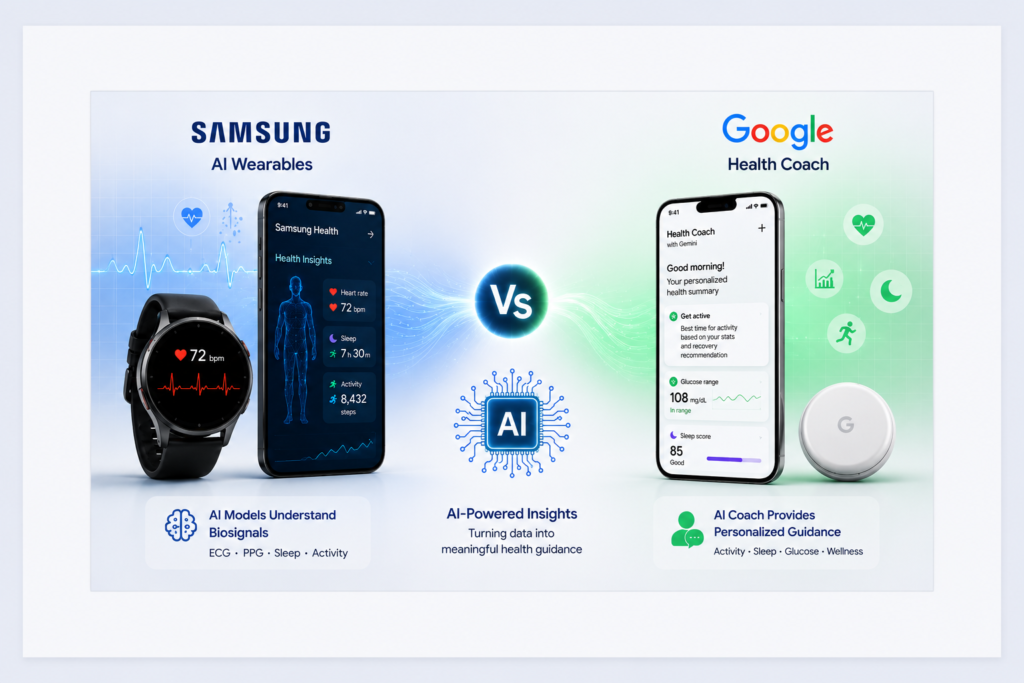
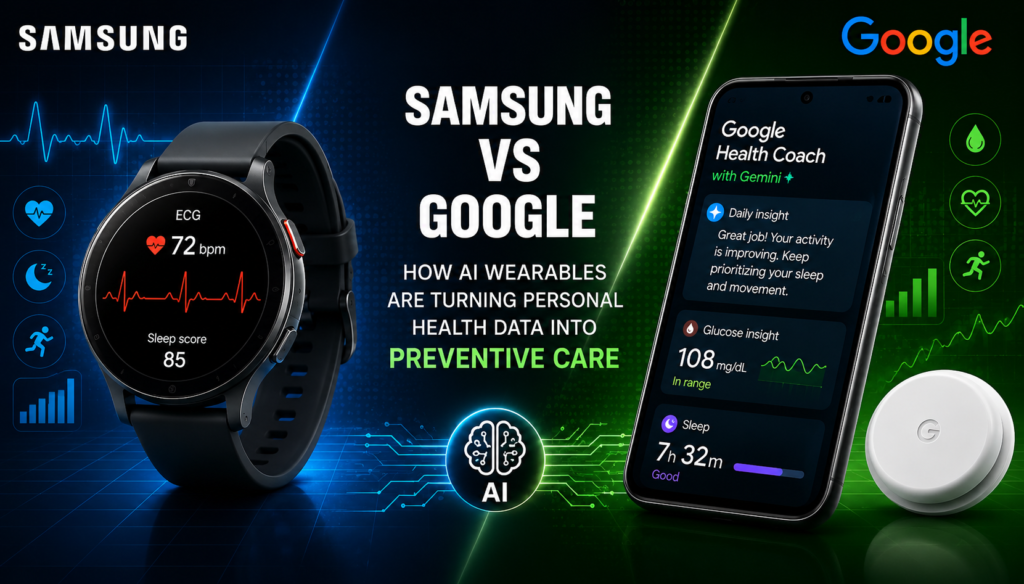
Samsung and Google are taking different approaches to this shift.
Samsung is researching AI foundation models that can learn from wearable biosignals such as ECG and PPG. Google, meanwhile, is expanding its Google Health ecosystem with a Gemini-powered Health Coach designed to turn personal health data into more personalized wellness guidance.
These developments point toward a larger change in AI health technology: wearable devices may gradually move from passive trackers to intelligent systems that help people understand their health data in context.
The technology is still developing,
an AI-generated health guidance should not be treated as a medical diagnosis. But the direction is clear: AI in healthcare is becoming more continuous, personalized and data-driven.
What Is AI in Healthcare?
AI in healthcare refers to the use of artificial intelligence to analyze health-related information, identify patterns and support healthcare or wellness applications.
In wearable technology, AI can process information from sensors such as heart-rate monitors, ECG, PPG, movement sensors and other biometric signals. The goal is not simply to collect more data, but to make that data easier to understand and potentially more useful.
Samsung’s biosignal research represents the model-development side of this trend, while Google’s Health Coach represents the personalized user-experience side.
Together, these approaches show how AI could become an important layer between wearable sensors and the people using them.
Samsung’s AI Approach: Teaching AI to Understand the Body
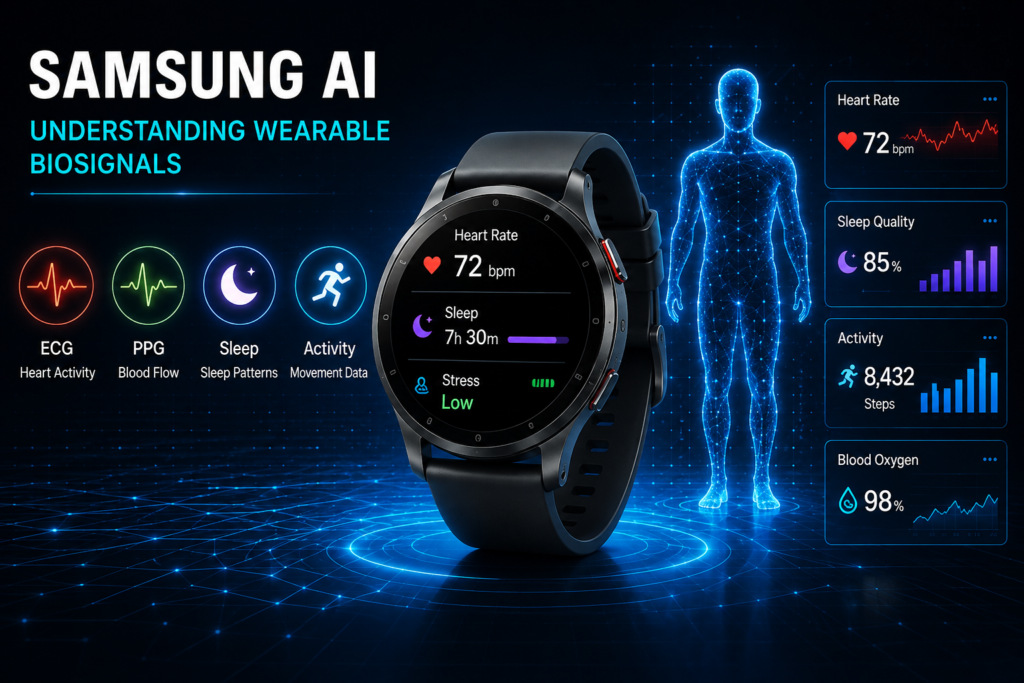
Samsung Research has been exploring ways to build AI models that can learn from the enormous amount of time-series information generated by wearable devices.
Unlike a traditional dataset containing isolated measurements, wearable biosignals change continuously over time. A smartwatch can capture information related to heart activity, sleep, physical activity, PPG and other physiological signals.
Samsung’s research focuses on learning useful representations from this type of data.
Two particularly interesting approaches are xMAE and HiMAE.
The broader idea behind this research is similar to the concept of a foundation model: instead of creating a completely separate model for every individual health-related task, a pretrained representation can potentially be adapted for multiple downstream applications.
That could eventually make AI-powered wearable technology more capable without requiring every device to run a large, general-purpose AI system.
What Is xMAE and Why Does It Matter?
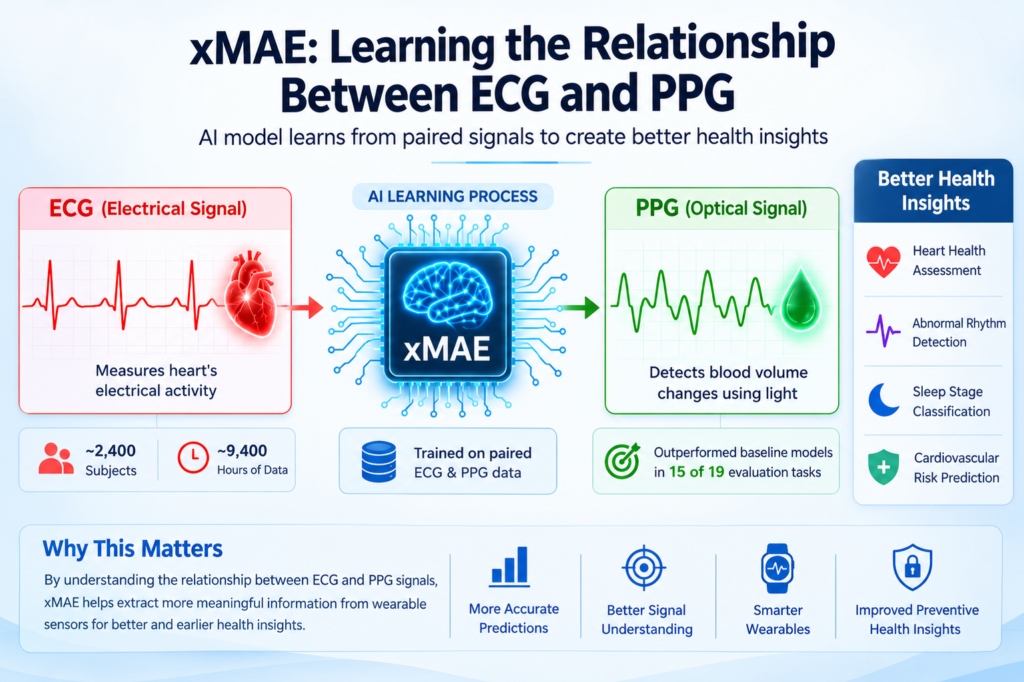
Samsung’s xMAE, or Physiology-Aware Masked Cross-Modal Reconstruction for Biosignal Representation Learning, focuses on the relationship between different physiological signals.
One of the most important relationships studied by xMAE is the connection between ECG and PPG.
Samsung’s research explains that xMAE uses paired ECG and PPG signals during training. ECG provides information about the heart’s electrical activity, while PPG captures the resulting peripheral pulse through optical sensing. The model uses this physiological relationship to improve the representations learned from PPG.
ECG vs PPG: What’s the Difference?
ECG, or electrocardiography, measures the heart’s electrical activity. It is commonly used to examine heart rhythm and other cardiac signals.
PPG, or photoplethysmography, uses optical sensing to detect changes associated with blood volume. PPG sensors are commonly found in smartwatches and fitness trackers.
The interesting part is that these signals are related but not identical.
If an AI model can learn how the two signals relate physiologically, it may be able to extract more useful information from PPG data collected continuously by wearable devices.
Samsung’s xMAE research used approximately 9.4k hours of paired ECG and PPG data from about 2,400 subjects and evaluated the learned representations across 19 downstream tasks. Samsung reports that xMAE outperformed unimodal and multimodal baselines on 15 of those 19 tasks.
That does not mean a smartwatch has suddenly become a medical diagnostic device.
Instead, the research demonstrates how AI foundation-model techniques could improve the way wearable biosignals are represented and analyzed.
HiMAE: AI That Understands Health Data Across Time
Samsung’s second approach, HiMAE (Hierarchical Masked Autoencoder), looks at wearable data from another perspective: time scale.
Health signals can contain useful information at very different temporal resolutions.
For example, a heartbeat can change over milliseconds, while sleep patterns develop over hours and broader activity or recovery trends can emerge over days.
HiMAE is designed to learn multi-resolution representations from wearable time-series data rather than treating every time scale in the same way.
Samsung says the model can identify resolution-specific structure in wearable data and perform well across classification, regression and generative tasks. It is also designed to be compact enough for smartwatch-class hardware, with sub-millisecond inference reported on smartwatch-class CPUs.
This matters because wearable devices have very different computing constraints from data-center servers.
A model that requires a large cloud infrastructure may not be practical for continuous processing on a smartwatch.
A smaller, efficient model could potentially perform more analysis directly on the device.
Why Multi-Scale Health AI Matters
Consider two examples.
A short-term change in a physiological waveform may contain information about an immediate event.
A much longer pattern could provide information about sleep, recovery or sustained activity.
A model that understands both levels could potentially extract more useful information than one that looks at only a single time scale.
That is the core idea behind HiMAE.
Google’s Approach: Gemini Health Coach and Personal Health Data
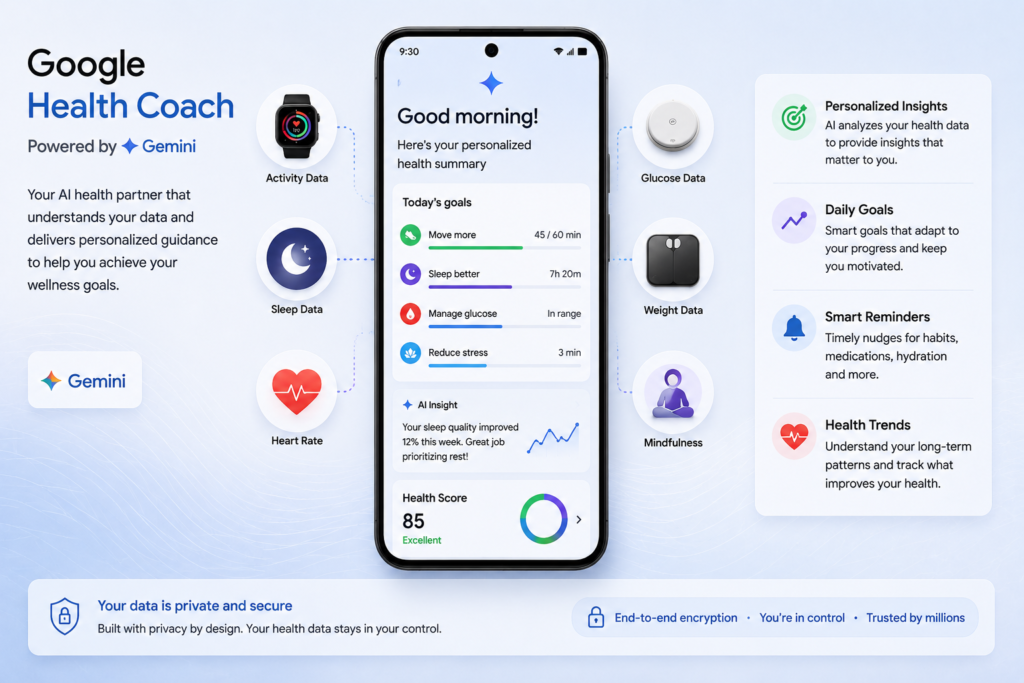
Samsung’s research is focused heavily on understanding wearable biosignals.
Google’s approach is more focused on turning health data into personalized guidance.
In 2026, Google introduced the Google Health app and made its Gemini-powered Google Health Coach publicly available. Google describes Health Coach as a personalized wellness experience that can provide guidance around fitness, sleep and health goals.
The Google Health app is designed to bring health and wellness information from multiple sources into one place, including wearable devices, Health Connect and Apple Health.
That creates a different type of opportunity.
Instead of asking only:
What does this sensor measure?
The AI layer can potentially ask:
What does all of this information mean together?
That shift from measurement to interpretation could be one of the most important developments in consumer health technology.
Why Continuous Glucose Data Matters for AI Health Coaching
Glucose is influenced by everyday factors such as food, physical activity and other lifestyle variables.
Continuous glucose monitoring can provide a stream of information rather than a single occasional measurement.
Abbott’s Lingo, for example, uses a biosensor based on continuous glucose-monitoring technology and is designed to translate glucose information into personalized insights.
For AI systems, continuous data creates an opportunity to identify relationships between different parts of a person’s daily routine.
Instead of simply displaying a glucose chart, an AI-powered health experience could potentially help users understand how different behaviors correlate with changes in their data.
That is the bigger opportunity behind AI-powered health coaching.
The value isn’t necessarily another dashboard.
The value is turning a large volume of personal information into insights that are easier to understand and act on.
Samsung vs Google: Two Different Approaches to AI in Healthcare
Samsung and Google are both working on AI and health, but their current approaches are different.
| Feature | Samsung | |
| Primary focus | Understanding wearable biosignals | Personalized health guidance |
| AI approach | Health foundation-model research | Gemini-powered Health Coach |
| Key data | ECG, PPG, sleep and activity signals | Health, fitness, sleep and connected wellness data |
| Key technologies | xMAE and HiMAE | Google Health + Gemini |
| Main opportunity | Better interpretation of physiological signals | Personalized wellness insights |
| Computing direction | Efficient wearable and edge AI | AI-powered health platform |
| Long-term potential | Smarter wearable intelligence | Connected personal health coaching |
The important point is that these aren’t necessarily competing technologies.
They represent different layers of the emerging AI-health ecosystem.
Samsung is working closer to the sensor and model layer.
Google is working closer to the data-platform and user-experience layer.
The future could combine both.
From Wearable Sensors to AI Health Assistants
The evolution of wearable technology can be viewed in three broad stages.
Stage 1: Data Collection
Early fitness trackers became popular because they could measure simple metrics such as steps, heart rate and sleep.
The main job was collecting information.
Stage 2: Data Interpretation
Machine learning made it possible to identify patterns in that information.
Instead of simply showing a number, software could provide trends, scores and summaries.
Stage 3: Intelligent Health Assistance
The next stage is turning those patterns into personalized, context-aware guidance.
This is where companies such as Samsung and Google are increasingly positioning their technologies.
Samsung is researching models capable of learning complex relationships within physiological signals.
Google is building a health platform where Gemini can connect different sources of information and provide personalized coaching.
The long-term goal could be a wearable ecosystem that doesn’t simply measure health, but helps users understand their data continuously.
Why On-Device AI Could Become a Major Advantage
One of the most important aspects of Samsung’s wearable AI research is efficiency.
Healthcare information is highly sensitive.
People may be comfortable sharing basic fitness information with an app, but continuous physiological data creates much larger privacy considerations.
If AI models can perform useful analysis directly on a smartwatch or smartphone, several advantages could emerge.
Faster Responses
Local processing can reduce dependence on network connectivity for certain tasks.
Lower Cloud Dependency
Not every analysis would necessarily need to be sent to a remote server.
Potential Privacy Benefits
Keeping certain processing on the device could reduce the amount of raw sensor information that needs to leave the user’s hardware.
Better Wearable Experiences
Smaller models can make advanced AI capabilities more practical on devices with limited processing power and battery capacity.
Samsung’s HiMAE research is particularly interesting in this context because the model is designed around efficient multi-resolution processing and reports sub-millisecond inference on smartwatch-class CPUs.
Of course, on-device processing does not automatically solve every privacy or security problem. Device security, data policies, permissions and model design still matter.
Google’s Advantage: Connecting Different Health Data Sources
Google’s strength is different.
The company already has a broad ecosystem of smartphones, wearable devices, health applications and AI services.
The Google Health app is designed to bring different types of health and wellness data together in one place. Google says the app can connect information from wearable devices, Health Connect and Apple Health, while the Health Coach is built with Gemini.
This creates an important possibility.
An AI system doesn’t have to look at one metric in isolation.
Instead, it can potentially consider a broader picture of a person’s daily patterns.
For example, fitness data could be considered alongside sleep information, activity levels and other available context.
That is where the real potential of personalized health AI begins to appear.
Why Multimodal AI Could Be the Bigger Breakthrough
The biggest story here may not actually be Samsung vs Google.
It may be the rise of multimodal health AI.
Human health is inherently multimodal.
The body generates multiple signals at the same time.
Heart activity, movement, sleep, glucose and other physiological measurements interact with one another.
An AI system that can understand relationships between these different signals could potentially produce richer insights than a system trained on only one type of data.
This is one reason foundation-model research in healthcare is attracting attention.
Instead of building one model for one narrowly defined task, researchers can build general representations and adapt them to different applications.
Samsung’s xMAE research is an example of using relationships between biosignals during training, while HiMAE explores how different temporal resolutions can reveal useful information in wearable data.
What AI Wearables Could Mean for Consumers
For everyday users, the long-term impact could be significant.
Imagine a future wearable ecosystem that can continuously understand:
- How you’re sleeping
- How active you are
- How your heart-related signals are changing
- How your glucose changes
- How your recovery is progressing
- How lifestyle choices correlate with your health data
The AI layer could then turn those measurements into understandable insights.
Instead of opening several different health applications, users could eventually interact with a single intelligent health assistant.
Google is already moving in this direction with Health Coach, which it describes as a personalized experience capable of connecting data and providing proactive guidance.
Samsung’s research represents another important piece of the puzzle: improving the intelligence that can be extracted from wearable sensor data.
The Limitations of AI in Healthcare
The potential is significant, but there are equally important limitations.
AI-generated health information should not automatically be treated as medical advice.
Google explicitly notes that Health Coach is not intended for medical purposes and that AI responses can be inaccurate or incomplete.
Similarly, strong results from a research model do not automatically mean that a consumer smartwatch can diagnose a disease.
There is a major difference between:
Research performance
and
Real-world clinical validation.
The real-world value of AI health systems will depend on several factors:
- Clinical validation
- Data quality
- Model accuracy
- Privacy and security
- Regulatory requirements
- Transparent communication of limitations
- Responsible use of AI-generated recommendations
This distinction is especially important as wearable devices become more sophisticated.
More data does not automatically mean better healthcare.
The quality of the data, interpretation and context all matter.
The Business Opportunity Behind AI-Powered Health Technology
From a technology perspective, digital health could become one of the most important application areas for AI.
Why?
Because healthcare generates enormous amounts of information, while consumers increasingly own devices capable of collecting data continuously.
This creates opportunities across several markets.
Wearable Technology
Smarter watches, rings, sensors and other wearable devices could collect and process more useful health information.
Digital Health Platforms
Health platforms could bring information from multiple devices and applications into a unified experience.
AI Coaching
AI assistants could turn complex health and wellness data into personalized recommendations.
Preventive Healthcare
Continuous monitoring could potentially help identify patterns earlier, although any medical application would require appropriate validation.
Healthcare Research
Longitudinal health data could support research into patterns that are difficult to observe through occasional measurements.
Medical AI
More advanced models could eventually support clinical research and decision-support applications where appropriately validated and regulated.
The combination of AI, sensors and continuous data could therefore create an entirely new category of consumer technology.
Samsung vs Google: Which AI Health Strategy Is Stronger?
It is too early to declare an overall winner because Samsung and Google are solving different problems.
Samsung’s Strength: The Wearable Intelligence Layer
Samsung’s research focuses on understanding physiological signals and creating efficient models that can potentially work within wearable-device constraints.
xMAE focuses on relationships between ECG and PPG, while HiMAE focuses on multi-resolution representations of wearable time-series data.
That gives Samsung an interesting position close to the sensor and device layer.
Google’s Strength: The AI Platform Layer
Google’s strength is its ability to connect health data with a broader software ecosystem.
The Google Health app brings together multiple sources of health information, while Health Coach uses Gemini to provide personalized guidance.
That gives Google a strong position at the interpretation and user-experience layer.
The Real Winner Could Be the Combination
The strongest future health platforms may eventually combine both approaches.
A wearable could collect and process physiological signals locally.
A broader AI platform could then use selected insights alongside other health information to provide personalized guidance.
That would create a system where:
Sensors collect → AI interprets → Platform connects → Assistant explains.
The Future of AI in Healthcare May Be Continuous
Traditional healthcare is often episodic.
A person visits a doctor, receives measurements, gets advice and returns later.
Wearables introduce something fundamentally different:
Continuous observation.
AI adds another layer:
Continuous interpretation.
Together, these technologies could gradually shift parts of healthcare and wellness toward earlier awareness and prevention rather than relying only on occasional measurements.
That does not mean AI will replace doctors.
A more realistic future is one where AI helps people and healthcare professionals organize information, recognize patterns and understand long-term trends more easily.
The biggest change may not be one spectacular AI feature.
It may be the gradual transformation of health data from something people occasionally check into something that is continuously interpreted.
Frequently Asked Questions
What is AI in healthcare?
AI in healthcare refers to artificial intelligence systems that analyze health-related information, identify patterns and support healthcare, research or wellness applications.
How are Samsung and Google using AI in healthcare?
Samsung is researching AI models for wearable biosignals, including ECG and PPG, while Google is using Gemini to power personalized health and wellness experiences through Google Health Coach.
What is xMAE?
xMAE is a Samsung Research biosignal representation-learning framework that uses the physiological relationship between ECG and PPG during training to improve PPG representations for wearable health applications.
What is HiMAE?
HiMAE is a Samsung Research hierarchical masked autoencoder designed to learn multi-resolution representations from wearable time-series data. Samsung reports that it can achieve sub-millisecond inference on smartwatch-class CPUs.
What is Google Health Coach?
Google Health Coach is a Gemini-powered health and wellness experience designed to provide personalized guidance around areas such as fitness, sleep and health goals. Google made it publicly available as part of Google Health Premium in May 2026.
Can AI wearables diagnose diseases?
Not automatically. Research models and consumer wearables should not be assumed to be medical diagnostic devices. Diagnosis depends on appropriate clinical evidence, validation and regulatory authorization where applicable.
Will AI replace doctors?
AI is more likely to support patients and healthcare professionals by organizing information, identifying patterns and providing context than to replace doctors entirely.
Why is multimodal AI important in healthcare?
Human health produces many different types of signals. Multimodal AI can potentially analyze relationships between signals such as movement, sleep, heart-related data and glucose instead of looking at each measurement independently.
Final Verdict
Samsung and Google are approaching AI in healthcare from two complementary directions.
Samsung is working on the intelligence required to understand complex physiological signals from wearable devices. Its xMAE and HiMAE research shows how AI models can be designed around the structure and timing of biosignals while remaining efficient enough for wearable hardware.
Google is building a broader health platform where Gemini-powered Health Coach can connect personal health and wellness information and turn it into more personalized guidance.
The bigger story is not simply which company has the better AI model.
It is the emergence of a new generation of AI-powered personal health technology.
As sensors become more capable, AI models become more efficient and health assistants become more personalized, wearable devices could evolve from simple trackers into intelligent health companions.
The next major competition in AI may not only be about who builds the smartest chatbot.
It may also be about who can build the smartest, safest and most useful AI layer between people and their own health data.
Medical Disclaimer
This article is for informational purposes only. AI-generated health insights and wearable data should not be considered a medical diagnosis or a substitute for professional medical advice. Always consult a qualified healthcare professional for medical concerns.
Stay Connected for More AI & Wearable Tech Updates!
Don’t miss the latest updates on AI wearables, Samsung Health, Google Health Coach, smartwatches, health tracking, and preventive healthcare technology. Follow our social channels to stay updated with the latest developments in AI-powered health technology:
- 📺 YouTube: Watch detailed explainers, AI wearable comparisons, product updates, and the latest health-tech trends — Subscribe to Our YouTube Channel
- 📸 Instagram: Follow us for quick tech updates, AI wearable insights, health-tracking features, and informative visual content — Follow Us on Instagram
- 📘 Facebook: Join the discussion and share your thoughts on Samsung, Google, AI-powered wearables, and the future of personalized healthcare — Follow Our Facebook Page
- 🌐 Website: Explore more articles covering AI, smart wearables, health technology, and the future of preventive care — Visit Our Website