


Best AI Tool for Business in 2026 | If you are running a business today, you have probably realized that the landscape has fundamentally shifted. A few years ago, we were experimenting with artificial intelligence—testing basic chatbots or playing around with generative art. Today, AI can no longer be treated as a fun experiment sitting at the edge of your business operations. It has to be embedded at the very core of what you do.
Embedded AI represents a profound shift from isolated AI features to entirely AI-native operations. I know this firsthand. Over the last few years, I have tested, broken, and successfully integrated hundreds of software platforms to scale my own digital operations. The businesses that are winning right now are moving AI directly into their transaction flows—inside their finance systems, their human resources, their supply chain planning, and their customer experience workflows.
But if you search the internet for the best AI tool for business, you are going to be bombarded with thousands of options. Every software company is slapping an “AI” label on their product to make a quick buck. Most of them are just shallow wrappers that will drain your budget and waste your time.
So, what actually works? Which platforms are actually earning their place in modern businesses right now?
In this comprehensive guide, I am going to share my personal, battle-tested tech stack. These are the tools I use daily to automate repetitive work, turn raw data into intelligent decisions, and create high-converting marketing campaigns. Here is the definitive list of the absolute best AI tools for businesses in 2026.
1. Gemini (by Google): The Best Overall AI Assistant & Workspace Integrator
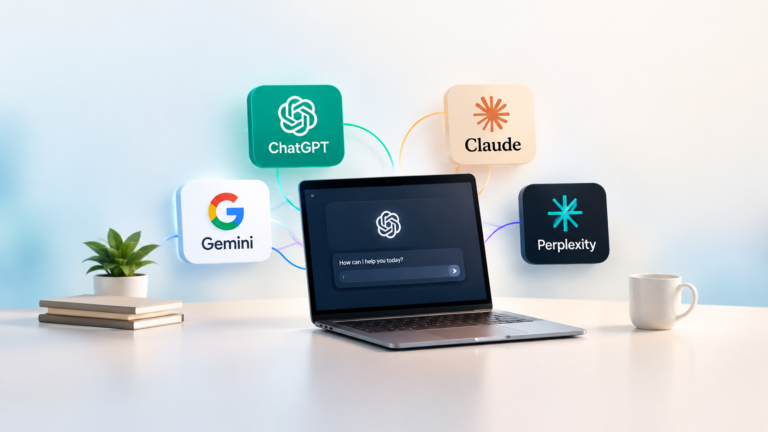
If someone backs me into a corner and forces me to name the single best AI tool for business overall, my answer in 2026 is Gemini. While there are many great large language models (LLMs) out there, Gemini stands out because it acts as an all-in-one AI chatbot that is deeply woven into the tools most businesses already use.
My Experience
I use Google Workspace for almost everything, and Gemini’s biggest benefit is its deep connection with apps like Google Docs, Sheets, and Gmail. Instead of having a conversation in a separate tab and copying the text over, Gemini is built right into the document. It has an incredibly large context window, meaning I can upload massive, dense documents and ask highly detailed questions, and it will provide accurate responses highlighting where the information was pulled from.
Additionally, its creative capabilities are top-of-the-line. It features Nano Banana Pro, an AI image model perfect for refining imagery, doing background swaps, and creating full scene transformations.
💡 Business Tips for Gemini: Best AI Tool for Business in 2026
- Automate Spreadsheet Logic: Use Gemini directly inside Google Sheets to get suggested enhancements in real-time; it is perfect if you are not adept at writing complex formulas.
- Repurpose Content with Audio: Use Gemini’s audio overview feature to convert long business documents into short, podcast-style summaries so your busy team can listen to updates on the go.
2. ChatGPT (by OpenAI): The Ultimate Logic & Research Engine
It is impossible to talk about the best AI tools for business without mentioning the platform that set the scene on fire: ChatGPT. It remains the industry leader and is arguably the most versatile tool you can have in your digital toolbelt.
My Experience
I use ChatGPT as my primary brainstorming partner, copywriter, and data analyst. It does a little bit of everything—from writing code and drafting sales emails to acting as a customer support simulator. The chat interface is brilliant for document analysis; I regularly upload PDFs, spreadsheets, and screenshots and ask it to summarize insights or highlight data trends.
OpenAI has also done a great job integrating its other models. For instance, you can tap into Sora 2 through ChatGPT to create cinematic, story-driven videos from written prompts.
💡 Business Tips for ChatGPT:
- Build Your Own GPTs: Don’t just use the default chat. Create custom, personalized “GPTs” trained on your company’s specific data and SOPs (Standard Operating Procedures) to handle highly specific internal tasks.
- Deep Research: Utilize ChatGPT’s deep research features, which received major updates in early 2026, to compile complex market research reports with better contextual understanding.
3. Zapier: The Operational AI Automation Backbone
Generative text is great, but business leverage comes from automation. Zapier is an absolute powerhouse that connects over 9,000 different apps, allowing your tools and AI to work together seamlessly.
My Experience
Zapier is where things get truly powerful; it is my AI productivity control center. Instead of manually moving data around, I use Zapier to build entire automated systems that react instantly to real-time triggers. Recently, they introduced “Zapier Agents,” which are intelligent, self-directed AI teammates that take multi-step actions autonomously across your tech stack.
💡 Business Tips for Zapier:
- Use the AI Copilot: If you don’t know how to code an automation, just use Zapier’s natural language Copilot. Tell it, “Summarize new leads in Slack every morning,” and it will draft the complete workflow, connect your accounts, and map the data for you.
- Build Custom Chatbots: Use Chatbots by Zapier to create a custom, no-code bot trained on your own website or help center content to answer customer questions automatically.
4. Jasper AI: The Marketing Content Powerhouse
If you are running a marketing team, generating high-quality content at scale is a constant struggle. Jasper started as a simple AI writing assistant, but by 2026, it has evolved into a full content operations platform.
My Experience
When I need to produce blog posts, ad copy, and SEO-optimized content at scale, Jasper is my go-to dedicated AI tool. What sets it apart from a standard chatbot is its ability to learn and strictly adhere to your brand’s unique tone of voice. It handles everything from drafting long-form articles to managing email campaigns and scheduling social media.
💡 Business Tips for Jasper AI:
- Enforce Brand Voice: Before writing anything, upload your best-performing marketing assets into Jasper to teach it your specific brand voice. This ensures the AI doesn’t sound generic or robotic.
- Scale Ad Variations: Use it to instantly generate dozens of different A/B testing variations for Facebook and Google Ads based on a single product description.
5. ClickUp Brain: The Intelligent Project Manager
Keeping a business organized is half the battle. ClickUp has long been recognized as a top-tier project management platform, but the addition of ClickUp Brain elevates it to the best AI task manager on the market.
My Experience
ClickUp Brain is a native AI chatbot built directly into your project management workspace. It integrates beautifully with tools like Figma and Dropbox. Instead of jumping between tabs to ask ChatGPT a question, I can ask ClickUp Brain to instantly summarize a messy, 50-comment task thread so I know exactly what my team is working on.
💡 Business Tips for ClickUp Brain:
- Generate Subtasks Instantly: Stop manually planning out every project phase. Create a parent task and ask the AI to automatically break it down into logical, assignable subtasks.
- Automate Status Updates: Use the AI to generate weekly progress reports based on task completions, saving you hours of administrative reporting.
6. Fireflies.ai: The Meeting Intelligence Engine
We all spend too much time in meetings. Fireflies.ai is an AI meeting transcription and intelligence tool designed to capture every detail so you don’t have to.
My Experience
I use Fireflies for almost every client call and internal sync. It joins the meeting, records the audio, provides an incredibly accurate transcription, and most importantly, generates intelligent summaries and action items. It is particularly brilliant for sales and account management teams who need to refer back to specific client requests without watching a 45-minute video replay.
💡 Business Tips for Fireflies.ai:
- Connect to Your CRM: Set up an automation so that Fireflies automatically pushes meeting summaries and extracted action items directly into your CRM (like Salesforce or HubSpot) after the call ends.
- Search Your Voice Conversations: Treat your past meetings like a search engine. Type in a keyword like “pricing complaint” to instantly find every time it was mentioned across months of sales calls.
7. Notion AI: The Central Knowledge Hub
A disorganized internal wiki is a massive productivity killer for startups and enterprises alike. Notion is already a wildly popular workspace, and Notion AI makes it exponentially more powerful.
My Experience
If you use Notion to consolidate your project documents, notes, and task management, adding the AI is a no-brainer. I use Notion AI to clean up messy meeting notes, draft internal planning documents, and extract key action items from long text blocks. It acts as a smart assistant that lives directly inside your company’s knowledge base.
💡 Business Tips for Notion AI:
- The “TL;DR” Generator: If a team member writes a massive, multi-page product requirement document, use Notion AI to add a quick “TL;DR” (Too Long; Didn’t Read) summary block at the very top.
- Translation and Tone Adjustment: Highlight a block of text and instantly ask the AI to change the tone from casual to professional before sharing it with external stakeholders.
8. ThoughtSpot: The Automated Business Intelligence Analyst
Data is useless if you can’t understand it quickly. ThoughtSpot is an AI analytics and decision automation tool that effectively gives your business a dedicated AI data analyst.
My Experience
Traditional Business Intelligence (BI) tools require technical knowledge to build dashboards. With ThoughtSpot, you can simply ask questions in natural language and receive instant insights and data visualizations. It connects seamlessly to cloud platforms without creating data silos. The generative AI (Spotter) removes the need for complex report requests and frees your team from manual data work.
💡 Business Tips for ThoughtSpot:
- Embrace Self-Service Analytics: Encourage your non-technical team members (like marketing or sales) to type natural language queries to find data themselves, reducing the dependency on your engineering or data teams.
- Rely on Anomaly Detection: Let the platform automatically monitor your data feeds and flag unexpected drops in revenue or spikes in traffic without you having to pull a report.
9. Canva Magic Studio: The Visual Design Automator
High-quality visual design used to require an expensive agency or a master’s degree in Adobe Photoshop. Today, Canva Magic Studio brings incredible AI design capabilities to small businesses and marketers.
My Experience
Canva automates design tasks beautifully. I use it to generate images, create entire presentation decks, and design social media posts in seconds. The AI tools inside the “Magic Studio” allow you to seamlessly expand backgrounds, magically erase unwanted objects from photos, or translate text inside a graphic to a different language with one click.
💡 Business Tips for Canva Magic Studio:
- The “Magic Switch” Feature: Design one master piece of content (like a horizontal YouTube thumbnail) and use the AI to instantly resize and reformat it into a vertical Instagram Reel cover and a square LinkedIn post.
- Generate Presentations Fast: Type a topic into the magic design tool, and Canva will automatically generate a highly stylized, multi-slide presentation deck complete with relevant graphics and layout structures.
10. KIME: The AI Search Visibility Tracker
Here is a tool that most businesses are entirely sleeping on. As more consumers turn to AI chatbots (like ChatGPT or Perplexity) to ask for product recommendations instead of using Google, businesses have a new problem: knowing how these AI models describe and rank their brand.
My Experience
KIME is an AI search intelligence platform that solves this exact problem. It helps businesses track, analyze, and improve how they appear in AI-generated responses across all the major LLMs. If you want to ensure your brand isn’t invisible in the new era of generative search, this is a must-have tool for marketing teams.
💡 Business Tips for KIME:
- Monitor Brand Sentiment: Use KIME to track exactly what ChatGPT is saying about your company versus your top competitors.
- Optimize for “LLM SEO”: Use the insights from the platform to adjust your website content, ensuring that large language models pull positive, accurate data about your brand when answering user queries.
How to Choose the Right AI Tools for Your Business
With so many powerful options, it is easy to get “shiny object syndrome” and subscribe to a dozen tools you will never actually use. To avoid wasting capital, here is a strategic framework for choosing the best AI tool for your business:
- Start with Your Biggest Operational Bottleneck: Don’t buy AI just to have AI. Look at where your team spends the most manual hours. If it is writing content, get Jasper AI. If it is moving data between apps, get Zapier.
- Consider Integration Capabilities: The most successful AI deployments are those that fit seamlessly into your existing workflows. If you are a heavy Google user, lean into Gemini. If you are deeply entrenched in the Microsoft ecosystem, look at tools like Power BI Copilot or Microsoft 365 Copilot.
- Evaluate Technical Capabilities: Be honest about your team’s skillset. Choose tools with natural language interfaces (like ThoughtSpot for data) so non-technical staff can actually use them.
- Calculate Real ROI: Don’t focus on theoretical benefits. Look at how many hours the tool will actually save you every month compared to its subscription cost.
- Start with a Pilot Program: Roll out a new AI tool to a small group of power users first. Invest in proper training, set clear success metrics, and plan for change management before pushing it company-wide.
The Final Verdict on the Best AI Tool for Business
The business landscape is changing faster than ever, driven by the democratization of advanced AI capabilities and predictive business intelligence. You do not need to be a massive enterprise corporation to leverage these technologies.
The best AI tool for business is simply the one that removes friction from your specific daily operations. Whether you are using Gemini to refine your Google Sheets, ChatGPT to debug code, or Zapier Agents to run autonomous workflows in the background, the key is implementation.
Stop watching from the sidelines. Pick the tools that address your biggest bottlenecks, start your free trials, and begin embedding artificial intelligence into the core of your business today.












One thought on “The Best AI Tool for Business in 2026: The Secret Stack I Use to Scale Faster”